

%22%2F%3E%3Cuse%20href%3D%22%23E%22%20fill%3D%22url(%23B)%22%2F%3E%3Cuse%20href%3D%22%23E%22%20x%3D%2291.28%22%20fill%3D%22url(%23C)%22%2F%3E%3Cpath%20d%3D%22M89.15%2C10.94v81.61H7.54c0-45.07%2C36.54-81.61%2C81.61-81.61h0Z%22%20fill%3D%22url(%23D)%22%2F%3E%3C%2Fsvg%3E)



Right now, somewhere in your organization, an accounts payable clerk is uploading invoices to ChatGPT. A legal assistant is pasting contract clauses into Claude. A loan officer is asking Gemini to extract data from mortgage applications. Your HR manager just fed a stack of resumes into a free AI tool they found on TikTok.
None of them are using your enterprise document processing system. None of them logged a ticket with IT. None of them think they're doing anything wrong. And that's the problem.
Welcome to the Shadow AI crisis in document processing, the fastest-growing compliance catastrophe that almost nobody is measuring. While your compliance team celebrates the rollout of your new intelligent document processing platform, your employees have already moved on. They're using whatever AI tool answers their questions fastest, processes their documents most easily, and doesn't require three approval workflows and a training session to access.
The numbers are staggering and they should terrify every CISO, Chief Risk Officer, and General Counsel reading this. Recent research reveals that 68% of enterprise employees who use generative AI at work are accessing it through personal accounts on public platforms. Even more alarming, 57% of these employees admit to entering sensitive company information into these unauthorized tools. Another study found that 55% of employees are using unapproved generative AI technologies at work, and here's the kicker: 22% continue using personal AI accounts even when their companies provide approved alternatives.
Think about what that means for document processing. Your enterprise spent millions implementing a secure, compliant intelligent document processing system. You've got SOC 2 certification, HIPAA compliance, audit trails, data residency controls, and enterprise-grade security. But more than half your employees are bypassing all of it because ChatGPT is faster and doesn't require them to remember another password.
The Hidden Scale: Document Workers Living in a Parallel AI Universe
Let me paint you a picture of what's actually happening in enterprises right now. Your procurement team is supposed to use the company's approved document extraction system to process purchase orders and invoices. The system works fine, technically. It extracts the data, validates it against your ERP, routes approvals through the proper channels. But it's clunky. The interface looks like it was designed in 2015 (because it probably was). It takes six clicks to upload a document and the error messages read like they were written by a developer having a bad day.
So what does your procurement specialist do when they've got 200 invoices to process before end of quarter? They open ChatGPT in another browser tab. They take a photo of each invoice with their phone and upload it. They ask the AI to extract vendor name, invoice number, line items, and totals. They copy the results into Excel. They paste them into the approved system. Job done in a fraction of the time.
From their perspective, they're being productive. They're meeting their deadlines. They're using AI to augment their work, which is exactly what the CEO said everyone should be doing in that company all-hands meeting. They don't see themselves as creating a security vulnerability or a compliance nightmare. They see themselves as getting their job done despite the limitations of enterprise IT.
Multiply this scenario across every department that touches documents. Legal teams are using public AI tools to review contracts, extract key terms, and identify risky language. Finance departments are feeding P&L statements and balance sheets into whatever AI tool gives them the fastest analysis. HR is using free resume parsing tools that promise to save them hours of screening. Healthcare administrators are asking AI to summarize patient intake forms and medical records. Insurance adjusters are uploading claims documentation to get quick assessments.
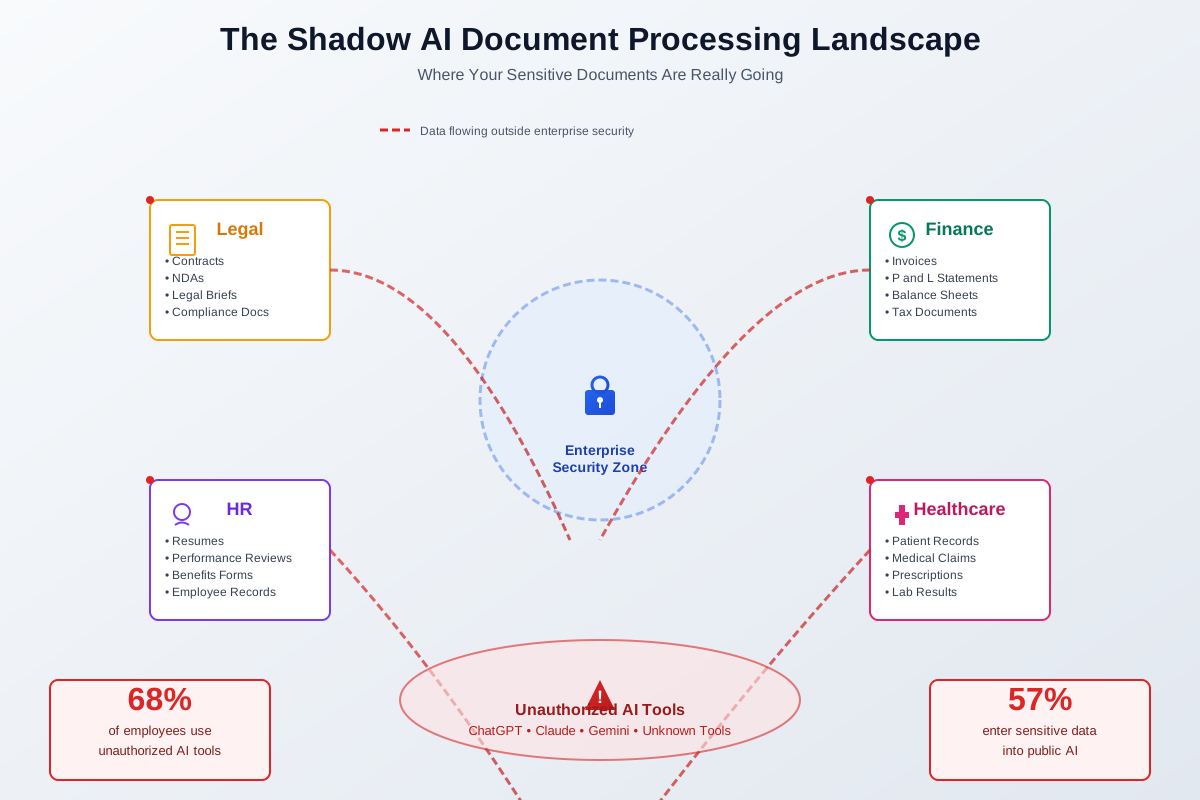
The infrastructure of Shadow AI in document processing is more sophisticated than you think. Employees aren't just casually pasting text into chatbots. They've built entire workflows around these unauthorized tools. They've got bookmarks, custom instructions, saved prompts, and even crude automation through browser extensions. Some teams have informal Slack channels where they share "AI hacks" for processing specific document types faster. There are shadow AI power users in your organization who've become the go-to experts for using these tools effectively, and they're training other employees on best practices that violate every policy you've put in place.
The most troubling part? Traditional security tools can't see most of this activity. These employees aren't installing unauthorized software. They're using web browsers to access publicly available services. The traffic is encrypted. The applications are browser-based. Unless you're doing deep packet inspection on every HTTPS session (which most enterprises aren't), this activity is invisible to your security operations center. You might have agent-based monitoring on endpoints, but Shadow AI operates in the cloud through standard web interfaces. By the time you know it's happening, thousands of documents have already left your security perimeter.
The Hallucination Time Bomb: When AI Makes Up Your Critical Business Data
Let's talk about what happens when your employees feed your documents into AI systems that have no accountability, no audit trail, and no connection to reality. OpenAI recently published research admitting something that should make every enterprise executive pause before their next board meeting. They confirmed that hallucinations in large language models aren't a bug that will eventually be fixed. They're a mathematical inevitability. Their o1 reasoning model hallucinates 16% of the time when summarizing public information. Their newer o4-mini model? It hallucinates 48% of the time. Nearly half of its outputs contain plausible but false information.
Now imagine those error rates applied to your business-critical documents. An invoice that says $10,000 gets transcribed as $100,000 by an AI that's pattern-matching numbers without understanding context. A contract clause that requires 30 days notice gets summarized as 3 days because the AI misread the text or made an assumption based on statistical likelihood. A medical record that states a patient is allergic to penicillin gets processed without that critical detail because the AI deemed it less relevant to the query being asked.
These aren't theoretical risks. They're happening right now in enterprises that have no idea their document processing has been quietly outsourced to unauthorized AI tools. The cascading failures are what should keep you up at night. When an employee uses Shadow AI to process a document, extracts incorrect information, and then enters that data into your systems of record, the hallucination becomes permanent. It propagates through your workflows, influences decisions, triggers automated processes, and eventually becomes part of your institutional knowledge.
A financial services company I spoke with recently discovered that a junior analyst had been using ChatGPT to summarize earnings reports for the past six months. The analyst would feed in PDF files of 50-page reports and ask for key highlights. The AI would generate beautifully formatted summaries that looked professional and authoritative. The problem? About 12% of the data points in these summaries were fabricated. Revenue figures that were close but not quite right. Guidance statements that were plausible but not what the company actually said. Risk factors that sounded reasonable but didn't appear in the original document. These summaries went into investment committee briefings. They influenced trading decisions. They became the basis for client recommendations. The company only discovered the problem when a client challenged one of their analyses and they went back to verify the source data.
The hallucination problem compounds in multi-document workflows, which is exactly how most enterprises process information. An employee uses Shadow AI to extract data from Document A. They feed that extracted data into another AI query about Document B. They combine insights from both to make a decision about Document C. At each step, there's a 15-30% chance of hallucination depending on which model they're using. By the time you get to the final output, you're not processing documents anymore. You're processing AI-generated approximations of documents, with error rates that would be unacceptable in any other business process.
The legal implications are staggering. In one notable case, an attorney used ChatGPT to conduct legal research and the AI fabricated case citations that didn't exist. The attorney submitted these fictional cases to the court. The judge discovered the fraud and sanctioned everyone involved. That was one lawyer making one mistake. Now scale that to an enterprise where hundreds of employees are using unauthorized AI to process thousands of documents daily. You're creating a systematic pipeline for introducing fabricated data into your business operations, and you have no way to detect or correct it until something breaks publicly.
The Compliance Gap: Regulations Meet Reality in the Worst Possible Way
Here's where the Shadow AI document crisis becomes an existential threat for regulated industries. Every major data protection and industry-specific regulation was written assuming that enterprises have visibility and control over how their data is processed. HIPAA assumes you know where patient information is going. GDPR assumes you can map data flows and respect individual privacy rights. SOX assumes your financial data processing has appropriate controls and audit trails. The SEC's new cybersecurity disclosure rules assume you actually know when your material data has been exposed.
Shadow AI destroys all of these assumptions. When your employees are processing documents through unauthorized AI tools, you have no idea where your data is going. You can't produce an audit trail. You can't demonstrate compliance with data residency requirements. You can't honor data subject access requests because you don't know what data was sent to which AI platforms. You can't ensure appropriate access controls because the access control is "whoever has a browser and an internet connection."
A recent study found that 55% of organizations are unprepared for AI regulatory compliance. But here's what that statistic doesn't capture. It's not just that they're unprepared for future AI regulations. They're currently violating existing regulations right now through Shadow AI document processing, and they don't even know it. When a healthcare administrator uploads patient intake forms to ChatGPT to save time on data entry, that's a HIPAA violation. When a bank employee pastes loan application details into Claude to speed up underwriting, that's likely a violation of financial services regulations. When a lawyer uses an unauthorized AI tool to review privileged communications, they may have just waived attorney-client privilege.
The regulatory hammer is coming, and it's going to hit hard. European regulators are already investigating enterprise AI usage for GDPR compliance. The Federal Trade Commission has made it clear they're watching how companies deploy AI and whether they're being truthful about privacy protections. State attorneys general are launching investigations into AI-powered data processing. When these regulators start asking questions, the first thing they'll want to see is your inventory of AI systems and data flows. What are you going to tell them when you discover that the majority of your document processing is happening through Shadow AI that you didn't even know existed?
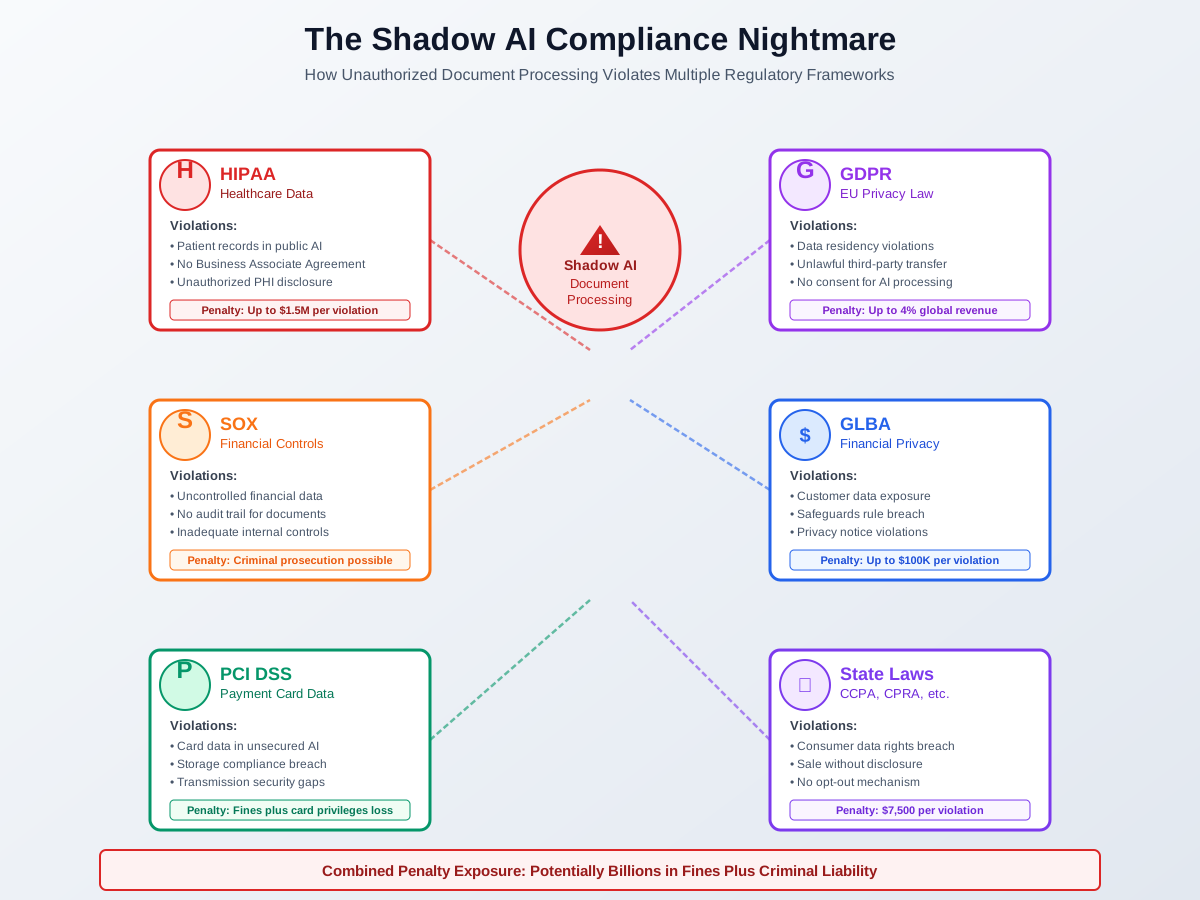
The penalty calculations are sobering. GDPR fines can reach 4% of global annual revenue. HIPAA violations can cost up to $50,000 per violation with an annual maximum of $1.5 million per violation category. For a healthcare organization that's been unknowingly processing patient documents through Shadow AI for a year, you could easily be looking at thousands of violations. SOX violations carry criminal penalties for executives who certify financial statements that were based on data processed through uncontrolled systems. These aren't just corporate fines, they're personal liability for officers and directors.
The audit trail nightmare is something most organizations haven't fully grasped yet. When you process documents through enterprise systems, you get logs. You know who accessed what document when, what changes were made, who approved the processing, what systems received the data. When documents go through Shadow AI, you get nothing. An employee can process 500 sensitive documents through ChatGPT and there's no record in your systems that it ever happened. If a regulatory inquiry asks you to demonstrate your data handling practices for documents processed in a specific time period, you literally cannot produce evidence for the Shadow AI portion of your operations. From a compliance perspective, that's indistinguishable from having no controls at all.
Why Traditional IDP Creates the Problem It's Supposed to Solve
Here's the uncomfortable truth that most enterprise software vendors don't want to admit. Traditional intelligent document processing systems are so painful to use that they actively drive employees toward Shadow AI. This isn't a user training problem. It's not a change management failure. It's a fundamental design problem baked into how most IDP solutions were built.
Think about the typical enterprise IDP implementation. It was probably selected by IT and procurement based on a technical requirements matrix. It integrates with your ERP system and your document management platform. It has all the security certifications and compliance attestations you need. It ticks every box on the vendor evaluation scorecard. And your employees hate using it because it was never designed with the actual human beings who process documents in mind.
The user experience gap is massive. Your employee needs to process an invoice. In the Shadow AI workflow, they open ChatGPT, upload the invoice, type "extract the vendor name, invoice number, date, line items, and total," and get results in 15 seconds. In your enterprise IDP workflow, they log into the system (assuming they remember their password), navigate through three nested menus to find the invoice processing module, upload the document to a specific folder, wait for the system to run its extraction pipeline, review the results in a clunky interface that requires horizontal scrolling to see all the fields, manually correct the inevitable errors from the rule-based extraction, and then trigger the approval workflow that will sit in someone's queue for two days. The enterprise system is more accurate, more secure, and more compliant. It's also five times slower and ten times more frustrating.
The rigidity of traditional IDP is another driver of Shadow AI adoption. These systems were designed for standardized document types with consistent formats. They work great when you're processing invoices from the same ten vendors you've been working with for years. They fall apart when you get a document that's slightly different from what the system was trained on. A vendor changes their invoice format. A new contract type comes through that doesn't match any existing template. A foreign language document needs processing. The traditional IDP system either fails completely or requires IT to retrain models and update rules, which takes weeks. What does the employee do in the meantime? They turn to Shadow AI, which handles format variations and new document types without breaking a sweat.
The deployment complexity of enterprise IDP also creates Shadow AI problems. Rolling out a traditional IDP solution typically takes six to twelve months. There are integration requirements, data pipeline setup, model training, user acceptance testing, compliance reviews, change control procedures, and training rollouts. By the time the system finally goes live, employees have already discovered AI tools that work instantly with zero setup. They've built habits and workflows around these tools. They've demonstrated to their managers that they can be more productive using Shadow AI than waiting for the official system. When IT finally announces the new enterprise IDP platform, the response is "why would I switch to something slower and more complicated than what I'm already using?"
The innovation cycle mismatch is another factor driving Shadow AI. Public AI platforms release major improvements every few months. Models get smarter, interfaces get better, new capabilities get added. Your enterprise IDP system gets annual updates if you're lucky, and those updates require extensive testing and change management. Your employees can see that ChatGPT or Claude keeps getting better at understanding documents while your enterprise system still struggles with the same edge cases it struggled with at launch. The rational response is to use the tool that's constantly improving, not the one that's frozen in time by enterprise IT policies.
None of this is to say that security and compliance don't matter. They absolutely do. But when you force employees to choose between doing their job effectively and following IT policies, a significant percentage will choose effectiveness every time. They'll rationalize it ("I'm not putting in anything that sensitive"), they'll minimize the risks ("everyone else is doing it"), and they'll continue processing documents through Shadow AI because the alternative is unacceptable from a productivity standpoint.
The Real Cost: $127 Billion and Your Competitive Position
Let's talk about what this Shadow AI crisis is actually costing enterprises. The $127 billion figure isn't pulled from thin air. It's a conservative estimate of the combined costs of data breaches, compliance violations, productivity losses from poor data quality, legal liabilities, and operational risks created by unauthorized AI document processing.
Start with the data breach costs. When employees process documents through unauthorized AI platforms, they're sending your data to third-party systems where you have no control over what happens next. These platforms may use your data to train their models (most do unless you have an enterprise agreement that explicitly prohibits it). They may store your data on servers in jurisdictions you don't approve. They may have security vulnerabilities you're not aware of. The average cost of a data breach in 2025 is approaching $5 million per incident. For enterprises processing thousands of documents through Shadow AI, you're essentially playing Russian roulette with your data security every single day.
The AI-powered data leak risk is now the top security concern for 69% of organizations according to recent surveys. Yet 47% of these same organizations have no AI-specific security controls in place. That gap between concern and action is where Shadow AI thrives. Companies know there's a risk, but they don't know how to measure it, they don't know how to detect it, and they don't know how to stop it without alienating their employees. So they do nothing, and the data keeps leaking.
Compliance violation costs are harder to quantify because many violations haven't been discovered yet. But look at the enforcement trends. GDPR fines have totaled over 4 billion euros since the regulation took effect. HIPAA settlements regularly reach seven and eight figures. SOX compliance failures can lead to criminal prosecution of executives. When regulators start focusing on Shadow AI document processing, the penalty exposure could dwarf any previous compliance crisis. We're talking about systematic, ongoing violations happening at scale across entire organizations, often for months or years before detection.
The productivity costs of bad data are insidious because they're hard to trace back to their source. When Shadow AI hallucinates data that gets entered into your systems, it doesn't announce itself with flashing lights and alarm bells. It just becomes another data point that looks slightly off. Someone makes a decision based on that data. The decision turns out poorly. Maybe you lose the deal. Maybe you misallocate resources. Maybe you launch a product that nobody wants because your market analysis was based on hallucinated data. You never connect the bad outcome back to the fact that an employee used ChatGPT to process a document three months ago and the AI made up 15% of the numbers.
The competitive disadvantage is perhaps the most overlooked cost. While your organization is dealing with Shadow AI chaos, your competitors who've implemented user-friendly, AI-powered document processing are moving faster. They're closing deals quicker because their loan processing takes days instead of weeks. They're more responsive to customers because their support teams can instantly analyze customer documents and resolve issues. They're making better decisions because they're working with clean, verified data instead of the hallucinated hodgepodge that accumulates when Shadow AI is your de facto document processing infrastructure.
The opportunity cost is massive too. Every hour your employees spend cobbling together Shadow AI workflows, correcting hallucinated data, or working around the limitations of inadequate enterprise systems is an hour they're not spending on high-value work. Your analysts should be generating insights, not wrestling with document extraction. Your lawyers should be providing strategic counsel, not manually reviewing AI-generated contract summaries for accuracy. Your healthcare administrators should be caring for patients, not debugging why the AI extracted the wrong diagnosis code.
The Shadow AI Elimination Strategy: Why Agentic AI Is the Only Real Solution
Here's the critical insight that most enterprises are missing. You can't solve Shadow AI with better policies or stricter enforcement. You tried that with Shadow IT for the past decade and it didn't work. Blocking access to ChatGPT just means your employees will find a different tool or use their personal devices. Threatening consequences for policy violations just means they'll hide their Shadow AI usage better. The only way to eliminate Shadow AI is to give employees something better than Shadow AI.
That's where agentic AI document processing changes everything. Unlike traditional IDP systems that force users into rigid workflows, agentic AI systems understand context, adapt to user needs, and provide the conversational interface that employees already love about public AI tools. The difference is that agentic AI operates within your enterprise security perimeter, maintains audit trails, enforces access controls, and connects to your systems of record.
Imagine a document processing experience that feels like ChatGPT but actually works within your compliance framework. An employee uploads an invoice and asks "what's the total amount and when is it due?" The system extracts the data, but unlike Shadow AI, it also validates the extraction against business rules, checks for duplicate invoices in your ERP, verifies the vendor against your approved supplier list, and routes the approval to the right person based on your spending policies. The employee gets the speed and simplicity they want, and you get the governance and control you need.
The user experience is the critical unlock. When your enterprise AI system is actually easier and better than public AI tools, employees stop having a reason to use Shadow AI. They're not being forced to comply with policies, they're choosing the better tool. That's the difference between grudging compliance and genuine adoption. Agentic AI document processing platforms can provide natural language interfaces where users describe what they need instead of navigating menus. They can handle document variations and new formats without requiring IT intervention. They can provide instant responses instead of making users wait for overnight batch processing.
The governance layer is what separates enterprise-grade agentic AI from consumer AI tools. Every document processed through the system gets logged with full metadata about who accessed it, what was extracted, what transformations were applied, and where the data went. When a regulator asks about your document handling practices, you can produce comprehensive audit trails instead of shrugging and hoping nobody processed anything sensitive through Shadow AI. The system enforces data residency requirements automatically. It applies role-based access controls so employees can only process documents they're authorized to see. It integrates with your data loss prevention tools so sensitive information doesn't leave your environment.
The accuracy and reliability advantages are substantial too. Agentic AI systems can be tuned to your specific document types and business requirements. They can connect to your knowledge bases to understand your company-specific terminology and processes. They can validate extractions against authoritative data sources instead of just pattern-matching like public AI tools. And critically, they can be configured to admit uncertainty instead of hallucinating. When the system isn't confident about an extraction, it can flag it for human review rather than making up plausible-sounding data.
The integration capabilities eliminate the need for employees to act as manual bridges between AI tools and enterprise systems. Instead of copying data from ChatGPT into spreadsheets and then pasting it into your ERP, the agentic AI system connects directly to your backend systems. It can trigger workflows, update records, generate reports, and orchestrate complex multi-step processes that would require dozens of manual actions in a traditional setup. The employee gets the productivity benefits they're looking for, without creating compliance nightmares or data quality problems.
The adaptive learning means the system gets better over time at understanding your specific documents and workflows. Unlike traditional IDP that requires expensive retraining cycles managed by IT, agentic AI can learn from user corrections and feedback. When an employee corrects an extraction, the system incorporates that learning to improve future processing. It's the best of both worlds: the flexibility and intelligence of AI with the governance and auditability of enterprise software.
What CISOs and Chief Risk Officers Need to Do Right Now
If you're a CISO or Chief Risk Officer reading this and starting to panic about your Shadow AI exposure, here's your action plan. First, you need visibility. You can't manage risks you can't see. Deploy Shadow AI discovery tools that monitor network traffic patterns, analyze application usage, and identify employees sending data to unauthorized AI platforms. These tools won't catch everything (especially usage on personal devices), but they'll give you a baseline understanding of the scope of the problem.
Second, conduct a Shadow AI document audit. Identify which departments are most likely to be processing sensitive documents. Interview employees about their actual workflows, not the workflows they're supposed to follow. Create a safe space for people to admit they're using unauthorized tools without fear of immediate punishment. You need the truth more than you need to enforce policies right now. Document which types of documents are going through Shadow AI, what data is being extracted, and where that data ends up in your enterprise systems.
Third, quantify your risk exposure. For each document type being processed through Shadow AI, assess the potential consequences of a data breach, compliance violation, or data quality failure. What happens if patient records processed through unauthorized AI lead to a HIPAA violation? What's the penalty exposure? What's the reputational damage? What happens if financial documents with hallucinated data influence investment decisions? What's the potential liability? Build a risk register that clearly articulates the stakes for your organization.
Fourth, brief your executive team and board of directors. This isn't an IT problem, it's an enterprise risk that requires C-suite attention and resources. Present the data on Shadow AI usage, the regulatory exposure, the data quality risks, and the competitive disadvantages. Be specific about potential penalties and the likelihood of enforcement. Make it clear that this is not a theoretical future risk, it's something that's creating enterprise liability right now.
Fifth, develop a Shadow AI elimination roadmap that focuses on replacement rather than restriction. Work with your document processing teams to understand why employees are using unauthorized tools. What capabilities are they getting from ChatGPT that they're not getting from your enterprise systems? What pain points in your current IDP platform are driving people to Shadow AI? Use these insights to define requirements for an enterprise solution that actually meets user needs.
Sixth, evaluate agentic AI document processing platforms that can provide the user experience employees want within your governance framework. Look for solutions that offer conversational interfaces, flexible document handling, fast deployment, and comprehensive integration capabilities. Prioritize platforms that can be rolled out quickly, you don't have time for a two-year implementation while Shadow AI continues undermining your compliance posture.
Seventh, implement a phased migration strategy that wins hearts and minds instead of just mandating compliance. Start with one high-impact use case where Shadow AI is prevalent and the risks are substantial. Deploy an agentic AI solution that provides a dramatically better experience than both the Shadow AI tools and your legacy IDP system. Let early adopters become champions who evangelize the solution to their peers. As word spreads that there's now a better alternative, Shadow AI usage will decline organically.
Eighth, establish ongoing monitoring and governance. Even after you've deployed an enterprise solution, some employees will continue using unauthorized tools out of habit or because they haven't been trained on the new system. Implement policies that are enforced but also reasonable, make it easy to use the approved tools and harder (but not impossible) to use unauthorized ones. Monitor for Shadow AI usage patterns and reach out to users to understand what's driving continued use of unauthorized tools. Treat it as a feedback mechanism for improving your enterprise systems rather than a disciplinary issue.
The Artificio Difference: Governed Intelligence Without Compromise
This is where we need to talk about what makes Artificio fundamentally different from both traditional IDP systems and the Shadow AI tools your employees are currently using. Artificio was built from the ground up to solve exactly this problem, providing the intelligence and ease of use that makes public AI tools attractive while maintaining the governance and control that enterprises require.
The Artificio platform centers on AI agents that understand documents contextually rather than just extracting text patterns. When an employee uploads an invoice, they're not interacting with a rigid form-filling exercise, they're having a conversation with an AI agent that understands what invoices are, what data matters, and what business rules apply. They can ask questions in natural language. They can request specific extractions or summaries. They can chain together multiple document processing tasks without leaving the interface. It feels like working with a smart assistant, because that's exactly what it is.
The critical difference is that every interaction happens within your security perimeter. The documents never leave your infrastructure. The extractions are validated against your business rules and data sources. The results are automatically integrated with your systems of record. You get complete audit trails showing who processed what document when and what actions were taken. When regulators come asking, you can demonstrate exactly how your document processing complies with all applicable regulations.
The flexibility of our agentic architecture means the system adapts to your documents instead of forcing your documents to adapt to the system. New vendor invoice format? The AI agents understand it without requiring IT to retrain models. Contract in a different language? The agents process it seamlessly. Unusual document structure that doesn't match any template? The agents apply their contextual understanding to extract what matters. This flexibility is what finally eliminates the need for employees to turn to Shadow AI for edge cases that traditional IDP can't handle.
The speed of deployment is another crucial advantage. We've seen enterprises go from initial evaluation to processing production documents in weeks rather than months. There's no lengthy integration project, no model training phase, no complex rule configuration. The AI agents come pre-trained on document understanding and adapt to your specific needs through our intuitive configuration interface. Your employees can be processing documents through a governed enterprise system faster than you can say "Shadow AI compliance violation."
The user adoption is dramatically higher because we designed the experience around how people actually work rather than how enterprise software typically assumes they should work. Our interface supports natural language queries, drag-and-drop document upload, real-time processing with instant feedback, and intelligent suggestions based on document content. Users describe it as "finally, enterprise software that doesn't feel like it was designed to punish me." When your employees actively prefer using the enterprise solution over Shadow AI, your compliance problems solve themselves.
The cost structure is designed to make the transition from Shadow AI economically compelling. We've seen organizations reduce their document processing costs by 70% while simultaneously improving quality and compliance. The ROI calculation is straightforward: you eliminate the hidden costs of Shadow AI (data breaches, compliance violations, bad data propagation) while gaining the efficiency benefits of proper AI-powered document processing. Most of our customers achieve full payback in less than six months.
The Mandate for Action: Your Board Will Ask About This Soon
Let me close with a prediction that should motivate immediate action. Within the next twelve months, shadow AI in document processing will transition from an obscure IT concern to a board-level risk that executives are expected to have a plan for. The regulatory scrutiny is increasing. The enforcement actions are beginning. The awareness of AI risks is spreading beyond technology teams to compliance, legal, and business leadership.
Your board of directors will start asking questions. Do we know how our employees are using AI to process documents? What's our exposure to compliance violations from unauthorized AI usage? How do we ensure data quality when employees are using tools we don't control? What's our strategy for eliminating Shadow AI without crushing productivity? When those questions come, and they will, you need to have answers that go beyond "we have policies against that" or "we're working on it."
The enterprises that act now will be ready with comprehensive answers. They'll demonstrate that they've assessed the Shadow AI landscape, quantified the risks, deployed solutions that provide better alternatives, and established governance frameworks that actually work. They'll show declining Shadow AI usage metrics, improving document processing quality scores, and clean audit trails that satisfy regulatory requirements. They'll be the case studies that other organizations reference when they're trying to figure out how to solve this problem.
The enterprises that delay will find themselves in an increasingly uncomfortable position. As regulators begin enforcement actions around Shadow AI document processing, as the first major breach or compliance failure makes headlines, as competitors gain advantages from implementing proper AI-powered document workflows, the pressure to act will intensify. But by then, you'll be acting from a position of crisis response rather than strategic planning. The costs will be higher, the timeline will be compressed, and the organizational disruption will be more severe.
The choice is yours. You can continue hoping that Shadow AI in document processing isn't as big a problem as this article suggests, that your employees aren't really putting sensitive documents into unauthorized AI tools, that regulators won't notice or care. Or you can face the reality that 68% of your document processing is happening outside your control right now, costing you $127 billion in aggregate risks, and creating compliance catastrophes that you're not even measuring yet.
The solution exists. Agentic AI document processing platforms like Artificio provide the governed intelligence your enterprise needs without the user experience compromises that drive Shadow AI adoption. The technology is ready, the implementation timelines are reasonable, and the ROI is compelling. The only question is whether you'll act before the crisis forces your hand.