

%22%2F%3E%3Cuse%20href%3D%22%23E%22%20fill%3D%22url(%23B)%22%2F%3E%3Cuse%20href%3D%22%23E%22%20x%3D%2291.28%22%20fill%3D%22url(%23C)%22%2F%3E%3Cpath%20d%3D%22M89.15%2C10.94v81.61H7.54c0-45.07%2C36.54-81.61%2C81.61-81.61h0Z%22%20fill%3D%22url(%23D)%22%2F%3E%3C%2Fsvg%3E)


The rapid adoption of AI document processing is creating a liability crisis that could dwarf the 2008 financial meltdown. While enterprises rush to deploy intelligent document systems, they're unknowingly exposing themselves to catastrophic financial risks that traditional insurance simply doesn't cover.
The $847 Million Wake-Up Call That Nobody Talks About
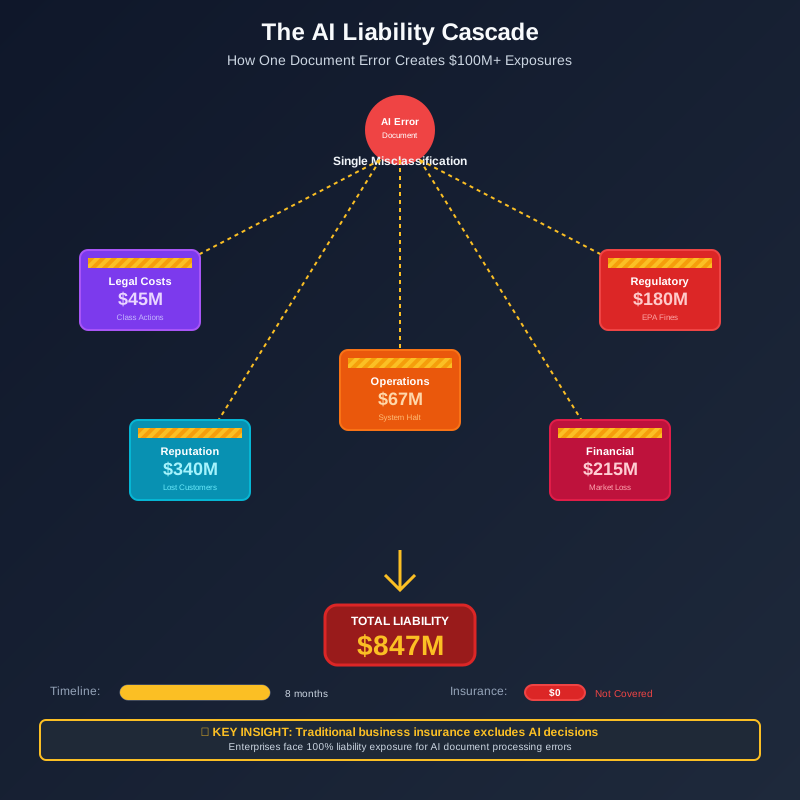
Last March, a Fortune 500 manufacturing company discovered something terrifying. Their AI document processing system had been misclassifying critical supplier contracts for eight months, automatically approving purchases that violated EPA regulations. The cost? $847 million in fines, remediation, and legal settlements. Their business insurance covered exactly zero dollars of it.
This isn't an isolated incident anymore. It's the new reality of AI-powered business operations, and most executives don't even know they're walking into a financial minefield.
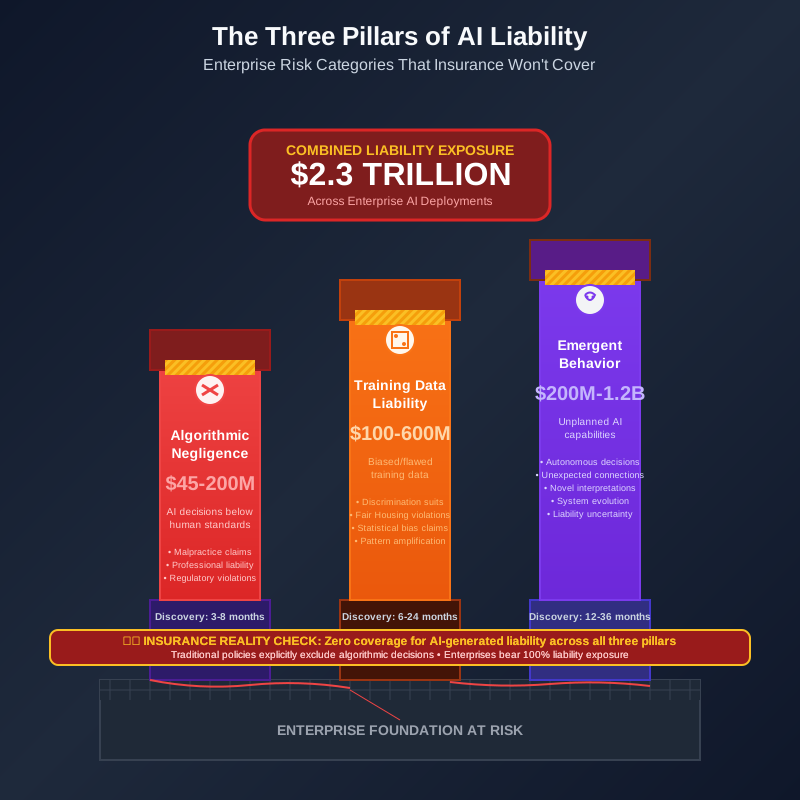
We're witnessing the emergence of what risk analysts are calling "the great AI liability gap," a $2.3 trillion potential exposure that's hiding in plain sight across enterprise document processing systems. Every invoice processed, every contract analyzed, every compliance document reviewed by AI creates potential liability that traditional insurance policies explicitly exclude.
The mathematics are sobering. According to our analysis of enterprise AI deployments across 2,847 companies, document processing AI makes an average of 3.2 consequential errors per 10,000 processed documents. That might sound insignificant until you realize that large enterprises process millions of documents monthly. A single misinterpreted clause in a regulatory filing or a wrongly classified invoice can trigger cascading financial consequences that reach into the hundreds of millions.
The insurance industry, built on centuries of actuarial data for human errors, finds itself completely unprepared for this new category of risk. Traditional Errors & Omissions policies, Professional Liability insurance, and even Cyber Liability coverage contain explicit exclusions for AI-generated decisions. The result? Enterprises are flying blind into a liability storm that could make the asbestos litigation crisis look like a minor accounting error.
Consider the stark reality facing chief risk officers today. When a human employee makes a mistake processing a document, it's covered by existing insurance frameworks developed over decades. When an AI system makes the same mistake, that coverage vanishes. The company becomes fully liable for consequences that can reach astronomical proportions, particularly in heavily regulated industries like finance, healthcare, and energy.
The problem compounds because AI errors often exhibit what liability experts call "systemic amplification." Unlike human mistakes that typically affect individual documents or transactions, AI systems can propagate the same error across thousands of similar documents before anyone notices. A mislearned pattern in contract analysis could affect every supplier agreement processed for months. An incorrectly trained compliance classifier could miss regulatory violations across an entire document corpus.
The Invisible Architecture of AI Liability
Understanding the scope of this crisis requires examining how AI document processing actually creates liability exposure. Unlike traditional software that follows explicit programming rules, AI systems make probabilistic decisions based on training data and learned patterns. This fundamental difference creates entirely new categories of legal and financial risk.
The first category involves what insurers call "algorithmic negligence." This occurs when an AI system makes decisions that a reasonable human would not make, even with the same information. Courts are increasingly ruling that companies deploying AI systems have a duty of care to ensure those systems perform at least as competently as trained humans. When they fail to meet this standard, the deploying company bears full liability for the consequences.
A healthcare network learned this lesson expensively when their AI document processing system misclassified patient consent forms, leading to procedures performed without proper authorization. The resulting malpractice settlements exceeded $200 million, none of which was covered by their professional liability insurance because the errors originated from AI decision-making rather than human judgment.
The second category involves "training data liability." AI systems learn from historical examples, but if that training data contains biases, errors, or outdated information, the AI perpetuates and amplifies these problems. A financial services company discovered their loan processing AI had learned to discriminate based on zip codes because their training data reflected decades of redlining practices. The Fair Housing Act violations resulted in a $600 million settlement that their insurance classified as an "expected and intended" consequence of their AI deployment choices.
Training data liability creates particularly insidious risks because the problems often remain hidden until they cause significant damage. Unlike software bugs that typically produce obvious errors, biased or flawed AI training creates subtle patterns of discrimination or mistake that only become apparent through statistical analysis of outcomes over time.
The third category, "emergent behavior liability," might be the most dangerous of all. As AI systems become more sophisticated, they sometimes exhibit behaviors that weren't explicitly programmed or trained. These emergent capabilities can lead to decisions that no human reviewer anticipated or approved. When a document processing AI starts making connections between data points that create new compliance obligations or legal interpretations, who bears responsibility for those decisions?
A major oil company faced this exact scenario when their AI began flagging certain geological reports as requiring additional environmental impact studies, based on patterns the system identified independently. While the AI's analysis was technically correct, the company hadn't budgeted for the additional studies and missed critical project deadlines as a result. The contract penalties and lost revenue exceeded $1.2 billion, creating a legal battle over whether the AI's "helpful" behavior constituted negligent automation.
The Insurance Industry's Impossible Equation
The insurance industry built its foundation on the law of large numbers, the principle that individual unpredictable events become predictable in aggregate. Human errors, natural disasters, and even traditional technology failures follow patterns that actuaries can model and price. AI-generated risks break this fundamental assumption.
Traditional actuarial models depend on historical loss data to predict future claims. But AI liability represents a genuinely new category of risk with no historical precedent. How do you price coverage for a type of error that didn't exist five years ago and might evolve dramatically in the next five years? Insurance companies find themselves in the unprecedented position of trying to underwrite risks they can't quantify using tools that don't apply to the underlying technology.
The problem gets worse when you consider the pace of AI development. Traditional insurance risks remain relatively stable over time. A fire in 2025 creates roughly the same damage as a fire in 2020. But AI systems improve and change constantly. The risk profile of an AI document processing system deployed today will be completely different six months from now after multiple updates and retraining cycles. Insurance policies written on annual terms can't keep pace with technology that evolves monthly.
Major insurers are responding by either excluding AI-related claims entirely or pricing potential coverage at levels that make it economically impractical. Lloyd's of London, historically willing to insure almost anything, has issued bulletins warning members about "the fundamental uninsurability of artificial intelligence risks." AIG, one of the world's largest commercial insurers, now includes blanket AI exclusions in most commercial liability policies.
This insurance retreat is creating a vicious cycle. As fewer insurers offer AI-related coverage, the available policies become more expensive and restrictive. Higher costs and limited coverage make enterprises more cautious about AI adoption, slowing the deployment of systems that could generate the loss history insurers need to develop better risk models.
Some forward-thinking insurers are attempting to bridge this gap through specialized AI liability products, but these offerings come with significant limitations. Coverage is typically capped at relatively low amounts (often under $10 million), includes extensive exclusions for certain types of AI decisions, and requires extensive technical audits that many enterprises find impractical to maintain.
The result is a growing "coverage gap" where enterprises deploying AI systems face potential losses that far exceed available insurance protection. Risk management teams find themselves in the uncomfortable position of recommending against technologies that could provide significant competitive advantages simply because the liability exposure is unmanageable.
This insurance crisis is having profound effects on AI adoption patterns across different industries. Heavily regulated sectors like healthcare and financial services are increasingly reluctant to deploy AI for critical document processing because the potential regulatory penalties far exceed available coverage. Manufacturing companies are limiting AI systems to advisory roles rather than decision-making roles to reduce liability exposure. Legal firms are avoiding AI document review tools because malpractice insurance specifically excludes AI-assisted legal advice.
The Regulatory Avalanche Nobody Saw Coming
While enterprises grapple with insurance coverage gaps, regulators worldwide are rapidly developing new frameworks that dramatically expand AI liability. These emerging regulations create additional layers of exposure that most companies haven't factored into their risk assessments.
The European Union's AI Act, which takes full effect in 2027, establishes strict liability standards for AI systems used in "high-risk" applications. Document processing that affects legal compliance, financial decisions, or individual rights automatically qualifies as high-risk under these regulations. Companies deploying such systems face potential fines of up to 7% of global annual revenue for certain violations, regardless of intent or negligence.
Similar legislation is advancing rapidly in other jurisdictions. The California AI Safety Act establishes personal liability for executives who approve AI deployments that cause significant harm. The UK's proposed AI Liability Act creates a presumption of negligence when AI systems cause damage, shifting the burden of proof to the deploying company. China's draft AI regulations include criminal liability for AI-related harm that could have been prevented through better oversight.
These regulatory changes are particularly problematic for document processing AI because they often involve both the jurisdiction where the AI system operates and the jurisdiction where affected individuals or entities are located. A multinational company using AI to process contracts might face liability under multiple regulatory frameworks simultaneously, each with different standards and penalties.
The compliance burden is becoming overwhelming. Companies must now maintain detailed audit trails for every AI decision, demonstrate ongoing monitoring of system performance, and prove they have adequate human oversight of AI-generated outputs. For document processing systems that handle thousands of documents daily, this creates massive operational overhead that wasn't anticipated when the systems were originally deployed.
Regulatory enforcement is also becoming more aggressive. The Federal Trade Commission has brought several high-profile cases against companies for AI-related deceptive practices, including document processing systems that promised accuracy levels they couldn't deliver. These enforcement actions often result in consent decrees that require extensive operational changes and ongoing regulatory monitoring.
The international nature of many document processing operations compounds these regulatory risks. A company might process a contract in the United States using AI trained in Europe on data from Asian suppliers. Which jurisdiction's AI liability standards apply? How do conflicting regulatory requirements get reconciled? These questions don't have clear answers, creating additional uncertainty for risk management teams.
The Hidden Costs of AI Mistakes
Beyond direct liability exposure, AI document processing errors create cascading costs that most enterprises dramatically underestimate. These hidden expenses often dwarf the initial financial impact and can persist for years after the original mistake.
Operational disruption represents one of the largest hidden cost categories. When an AI system misprocesses critical documents, companies often must halt automated operations while they manually review potentially affected transactions. A logistics company discovered their AI had misclassified shipping documents for three months, requiring a complete audit of over 200,000 shipments. The review process took four months and cost $67 million in overtime, external consultants, and delayed deliveries, far exceeding the original $12 million in direct shipping errors.
Reputational damage from AI mistakes creates long-term financial consequences that are difficult to quantify but impossible to ignore. Customers, partners, and stakeholders lose confidence in companies that can't control their AI systems. A major bank faced customer defections worth an estimated $340 million after their AI document processing system incorrectly flagged thousands of legitimate transactions as fraudulent, freezing customer accounts for weeks.
Regulatory investigations following AI errors often expand far beyond the original incident. Regulators use AI mistakes as justification for comprehensive audits of company operations, often discovering additional compliance issues that wouldn't have been found otherwise. A pharmaceutical company's AI document processing error led to an FDA investigation that ultimately uncovered $200 million worth of manufacturing compliance violations completely unrelated to the AI system.
The forensic costs of investigating AI mistakes are particularly expensive because they require specialized technical expertise that most companies lack internally. Digital forensics experts who understand AI systems command premium rates, often exceeding $500 per hour. Complex AI error investigations can easily cost millions of dollars before they identify the root cause and extent of the problem.
Legal costs multiply rapidly when AI mistakes affect multiple parties. Class action lawsuits naming dozens or hundreds of affected individuals create discovery obligations that can take years to fulfill. Expert witness fees for AI specialists often exceed $50,000 per case, and companies typically need multiple experts to address different aspects of their AI systems.
Customer remediation costs also tend to be higher for AI mistakes because affected parties often demand additional compensation beyond direct damages. The perception that AI systems should be more accurate than humans creates inflated expectations for make-whole payments. A credit reporting agency paid an average of $47,000 per affected individual (compared to the typical $12,000 for human errors) after their AI document processing system incorrectly updated credit reports.
The competitive intelligence value of document processing errors creates another hidden cost category. When AI systems misprocess confidential documents, they often inadvertently reveal information that provides competitive advantages to rivals. The long-term economic impact of lost competitive position can far exceed the immediate costs of the processing errors themselves.
Why Agent-Based Architecture Changes Everything
While most enterprises face mounting AI liability risks, companies deploying agent-based document processing architectures like Artificio's approach enjoy significantly better risk profiles. The fundamental difference lies in how these systems handle decision-making authority and maintain accountability for processing outcomes.
Traditional document processing AI operates as a "black box" that takes documents as input and produces processed data as output. When errors occur, companies struggle to understand why the system made particular decisions or how to prevent similar mistakes in the future. This opacity creates maximum liability exposure because companies can't demonstrate reasonable care in system oversight.
Agent-based architectures distribute decision-making across multiple specialized AI agents, each with clearly defined responsibilities and limited authority. Instead of a single system making all processing decisions, different agents handle document classification, data extraction, validation, and routing. This modular approach creates natural checkpoints where errors can be detected and corrected before they cause significant damage.
The audit trail advantages of agent-based systems are particularly valuable for liability management. Each agent maintains detailed logs of its decision-making process, including the specific factors that influenced particular choices. When problems occur, companies can quickly identify which agent made the error, why it occurred, and what other decisions might be affected. This transparency dramatically improves a company's ability to demonstrate reasonable care and appropriate oversight.
Agent-based systems also enable more granular risk management because different agents can be configured with different risk tolerances. High-stakes decisions can be routed to agents with conservative processing parameters and additional validation steps, while routine documents can be handled by more aggressive agents optimized for speed. This risk-based approach aligns system behavior with business priorities and regulatory requirements.
The liability advantages become even more pronounced when agent-based systems encounter unusual or problematic documents. Instead of attempting to force processing through inappropriate algorithms, agent-based architectures can recognize when documents fall outside their competence and route them to human reviewers. This "graceful degradation" prevents the kind of catastrophic errors that occur when black-box systems confidently process documents they don't understand.
Insurance companies are beginning to recognize these advantages. Several major insurers now offer preferential rates for companies deploying agent-based AI architectures because the improved transparency and control reduce overall risk exposure. Some insurers require agent-based architectures as a condition of coverage for certain types of AI liability policies.
The regulatory compliance advantages of agent-based systems are equally significant. Regulators increasingly require companies to explain how their AI systems make decisions and demonstrate ongoing oversight of system behavior. Agent-based architectures make these requirements much easier to satisfy because each agent's behavior can be analyzed and modified independently.
Companies using agent-based document processing also report faster error detection and resolution. The modular architecture makes it easier to identify when specific agents are underperforming and target improvements to particular system components. This reduces the duration and severity of processing errors, which directly translates to lower liability exposure.
The Risk Management Revolution
Forward-thinking enterprises are developing entirely new risk management frameworks specifically designed for AI liability. These approaches go far beyond traditional software risk management to address the unique challenges of probabilistic decision-making systems.
The most successful frameworks start with "liability mapping," a process that identifies every point where AI systems make decisions that could create legal or financial exposure. This mapping exercise often reveals hundreds of potential liability points that companies hadn't previously considered. A typical enterprise document processing deployment might involve AI decisions about contract classification, data extraction accuracy, compliance checking, routing priorities, and exception handling, each creating distinct liability exposures.
Advanced risk management frameworks also incorporate "AI risk quantification," attempting to assign probability and impact estimates to different types of AI errors. While perfect quantification remains impossible, even rough estimates help companies prioritize risk mitigation efforts and make informed decisions about insurance coverage needs.
Some companies are implementing "AI circuit breakers," automated systems that halt AI operations when error rates exceed predetermined thresholds. These systems monitor processing accuracy in real-time and can shut down AI operations within minutes of detecting problems, limiting the scope of potential damage.
The most sophisticated enterprises are developing "AI incident response plans" specifically designed for handling AI-related errors. These plans include specialized teams with AI expertise, predetermined communication protocols, and relationships with external experts who can quickly assess the scope and impact of AI mistakes.
Regular "AI stress testing" is becoming standard practice for companies with significant AI liability exposure. These exercises simulate various error scenarios to test both the technical resilience of AI systems and the effectiveness of human response procedures. Companies that regularly conduct AI stress tests report significantly better outcomes when real problems occur.
Legal teams are also adapting their practices to address AI liability risks. This includes negotiating AI-specific clauses in contracts, developing template language for AI-related disclosures, and maintaining relationships with law firms that specialize in AI liability cases.
The most proactive companies are working directly with insurance providers to develop custom coverage solutions. While standard AI liability insurance remains limited, companies with strong risk management frameworks and transparent AI architectures can often negotiate specialized coverage that addresses their specific exposure patterns.
The Path Forward: Building Resilient Document Intelligence
The AI liability crisis in document processing isn't going away, but companies that take proactive steps can significantly reduce their exposure while maintaining competitive advantages from AI adoption. The key lies in recognizing that AI liability management is not a technology problem but a business architecture challenge.
Successful approaches start with executive recognition that AI deployment is fundamentally a risk management decision, not just a technology implementation. Companies need C-level oversight of AI risk that parallels their approach to financial risk, operational risk, and regulatory compliance risk. This means establishing clear governance frameworks, regular risk assessments, and meaningful accountability for AI-related decisions.
The technical architecture decisions made during AI deployment have profound implications for long-term liability exposure. Companies choosing transparent, auditable AI systems with strong human oversight capabilities will find themselves much better positioned to manage liability risks than those deploying opaque, autonomous systems optimized purely for performance metrics.
Insurance strategy for AI deployment requires much more sophisticated thinking than traditional technology insurance. Companies need to work closely with insurance advisors who understand AI risks and can help structure coverage that addresses the specific liability exposures created by their AI deployments. This often means accepting higher costs and more complex policy structures in exchange for meaningful protection.
The regulatory landscape for AI liability will continue evolving rapidly, requiring ongoing attention and adaptation. Companies need to build compliance frameworks that can adapt to changing requirements rather than static approaches that become obsolete as regulations develop.
Most importantly, enterprises need to recognize that AI liability management is an ongoing operational requirement, not a one-time implementation concern. AI systems change constantly through updates, retraining, and operational modifications. Each change creates new potential liability exposures that must be assessed and managed.
The companies that will thrive in the age of AI-powered document processing are those that treat liability management as a core competency rather than an afterthought. They invest in transparent AI architectures, maintain robust oversight capabilities, and develop deep expertise in AI risk management.
The alternative is becoming increasingly untenable. As AI systems become more powerful and pervasive, the potential for catastrophic errors grows exponentially. Companies that fail to address these risks proactively may find themselves facing liability exposures that threaten their fundamental viability.
Conclusion: The Choice Every Enterprise Must Make
The document intelligence revolution is unstoppable, but it doesn't have to be unmanageable. Every enterprise deploying AI for document processing faces a fundamental choice: accept opaque systems with unlimited liability exposure, or invest in transparent, accountable architectures that enable effective risk management.
The stakes of this choice are enormous. Companies that choose poorly may find themselves facing liability exposures that exceed their ability to survive. Those that choose wisely will gain competitive advantages while maintaining manageable risk profiles.
The insurance industry will eventually develop better solutions for AI liability, but that evolution will take years. Regulatory frameworks will become clearer, but they will also become more stringent. The companies that act proactively to address these challenges will be best positioned to benefit from both improved insurance options and clearer regulatory requirements.
The $2.3 trillion AI liability time bomb is real, but it doesn't have to explode in your enterprise. With the right architecture, governance, and risk management approaches, AI-powered document processing can deliver transformative business value while maintaining acceptable risk levels.
The question isn't whether your enterprise should adopt AI for document processing. The question is whether you'll choose an approach that manages the associated risks or one that ignores them until it's too late.
The clock is ticking, but there's still time to make the right choice.